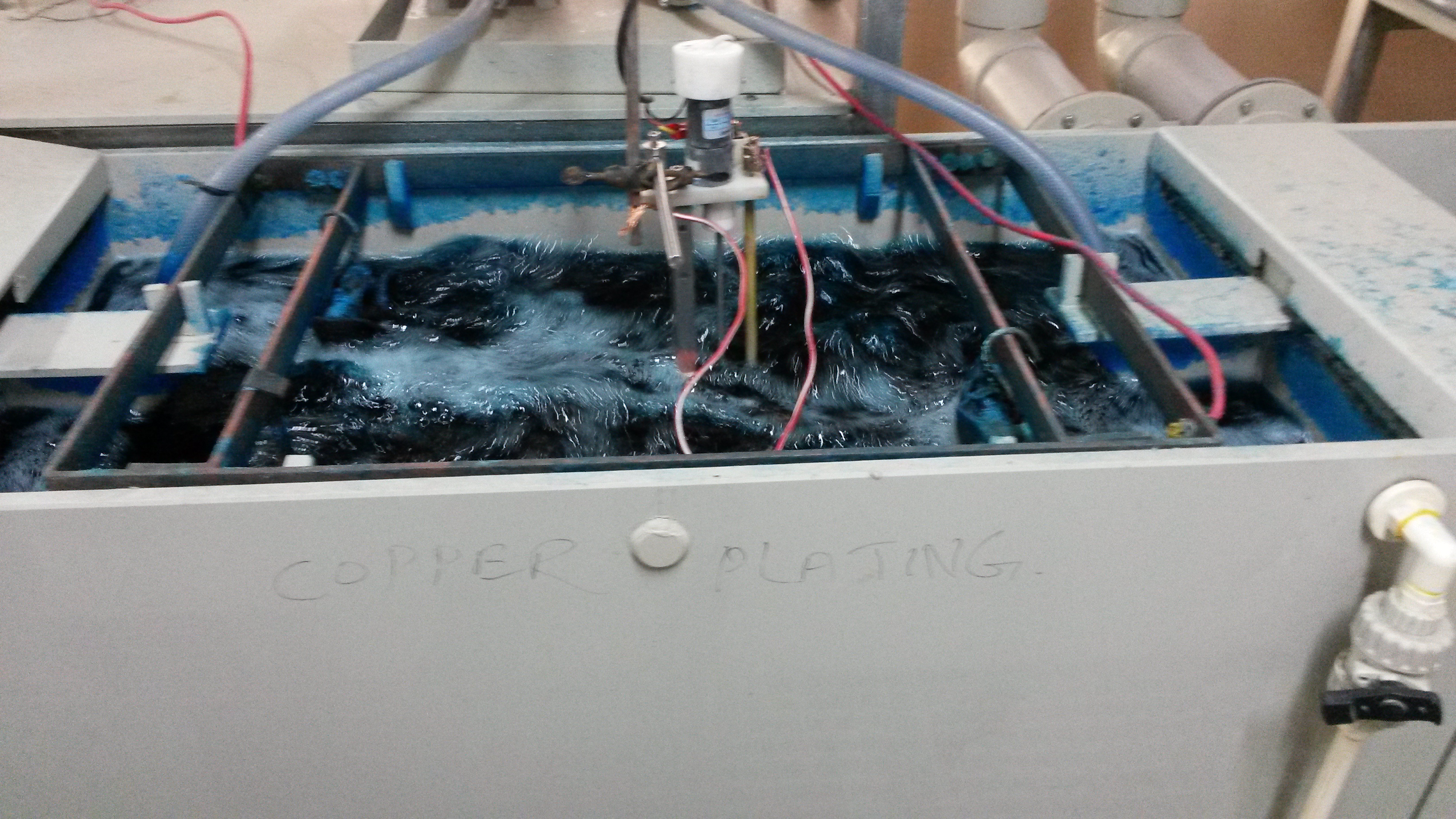
For copper plating, the substrate is attached to the cathode (negative electrode) in the centre of the container and pieces of pure copper form the two anodes (positive electrode). The electrolyte (solution in which electrodes are inserted in) is made up of copper sulphate.
At the anode:
Cu —–> Cu2+ + 2e–
The copper piece attached to the anode oxidises (loses electrons) due to the potential difference applied. The Cu ions then move into the solution, and the electrons lost flow from the anode towards the cathode.
At the cathode:
Cu2+ + 2e– —–> Cu
The copper ions get deposited at the cathode where they gain electrons (which have travelled from the cathode), to form Cu atoms.
The image below shows the process in action. As you can see, the electrolyte is continuously stirred to ensure the concentration of copper ions throughout the solution remains constant, which in turn helps ensure that copper is evenly electroplated over the substrate.
Electroplating with gold involves an inert anode, i.e., one that does not take part in the reaction. As a result, a non-reactive metal needs to be used for the anode, which in this case is either Platinum or Graphite. The electrolyte contains the gold ions that move toward the cathode, i.e., toward the substrate. In this case, the electrolyte used is complex salt ion gold cyanide {Au (CN)2}-1 dissolved in water. The process can be represented as follows:
At the anode:
4H20 —-> 4 H+1 + 2 O2 + 4 e–
The water molecules move towards the inert anode, where the oxygen oxidises (loses electrons) to form oxygen molecules and the hydrogen becomes ions. The 4 electron lost then flow towards the anode.
At the cathode:
4(Au (CN)2)-1 + 4 e– ——-> 4 Au + 8 CN-1
The negatively charged gold cyanide molecules move towards the cathode where the gain 4 electrons (which have travelled from the cathode), to form gold atoms and cyanide ions. The gold atoms get deposited onto the surface and the cyanide ions go back into solution.
 Divyanshu Pachisia